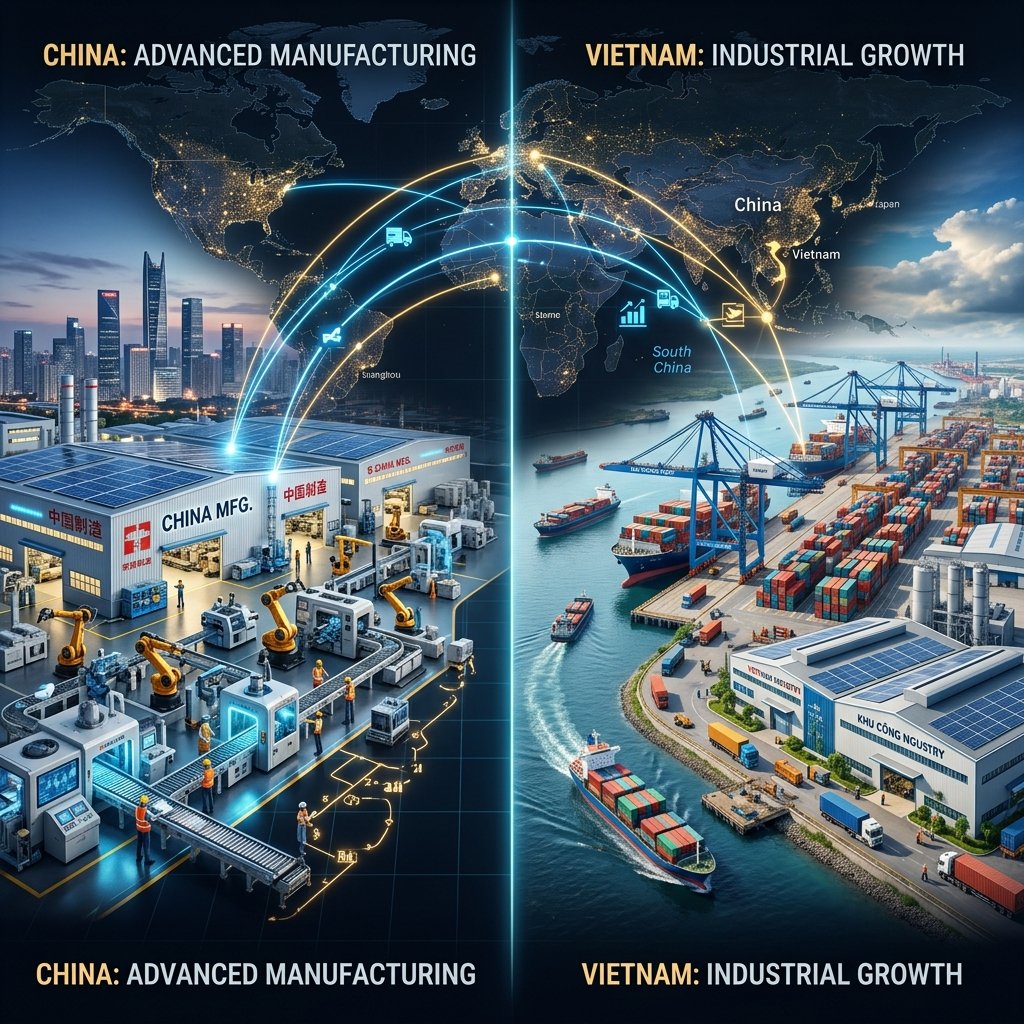
The "China Plus One" Strategy in 2026: Why is it Crucial?
In the wake of shifting geopolitical landscapes and unpredictable trade tariffs, the "China Plus One" strategy has evolved from a cautious backup plan into a mandatory business imperative. By 2026, relying solely on Chinese manufacturing exposes businesses to severe supply chain vulnerabilities. Importers must diversify. Vietnam has emerged as the clear winner in this diversification race, absorbing massive investments from multinational corporations seeking stability, lower costs, and tariff-free access to Western markets.
This strategy doesn't mean abandoning China entirely; rather, it's about shifting sensitive or highly-taxed product lines (like furniture, textiles, and electronics) to Vietnam while maintaining complex component sourcing in Shenzhen or Guangzhou. Let's compare these two manufacturing giants across key metrics.
Vietnam vs China: Cost Comparison (Labor & Materials)
Historically, China was the undisputed champion of low-cost manufacturing. However, as China's middle class expands, its minimum wage has risen significantly. In 2026, Vietnam maintains a distinct advantage in labor costs.
Labor Costs
The average manufacturing wage in Vietnam remains approximately 40% to 50% lower than in China's coastal manufacturing hubs (such as Guangdong and Zhejiang). For labor-intensive industries like apparel, footwear, and wooden furniture, this wage disparity translates directly into higher profit margins for importers. Primo Sourcing regularly helps clients achieve 15-20% overall cost reductions simply by migrating these specific product lines across the border.
Raw Materials
China still holds the upper hand in raw material ecosystems. Its deep supply chains mean almost every component, from zippers to microchips, is available domestically. Vietnam often imports specialized raw materials (especially fabrics and complex electronic components) from China before assembling the final product. However, for industries like wooden furniture or agricultural products, Vietnam boasts abundant, high-quality domestic resources.
Infrastructure and Logistics: Can Vietnam Match China?
China's infrastructure is world-class. Its massive network of high-speed rail, highways, and automated mega-ports (like Shanghai and Ningbo) ensures incredibly fast turnaround times.
Vietnam has made aggressive strides to catch up. The expansion of deep-water ports, such as Cai Mep in the South and Lach Huyen in the North, allows direct shipments to the US and Europe without transshipment via Singapore or Hong Kong. While Vietnam's internal road network is still developing compared to China's pristine highways, the coastal concentration of its industrial zones mitigates major logistics delays. Transit times from Vietnam to the US West Coast are now highly competitive, often taking just 18-22 days.
Trade Agreements: EVFTA and CPTPP vs US-China Tariffs
The most significant divergence between Vietnam and China lies in international trade policy. The ongoing trade friction between the US and China has led to Section 301 tariffs, adding up to 25% (or more) on thousands of Chinese imports.
Conversely, Vietnam has actively integrated into the global economy through strategic Free Trade Agreements (FTAs). For European buyers, the EVFTA (EU-Vietnam Free Trade Agreement) has eliminated nearly 99% of customs duties. For countries in the Americas and Asia-Pacific, the CPTPP offers similar tariff-free advantages. Sourcing from Vietnam often bypasses the heavy punitive taxes levied on Chinese goods, dramatically altering the landed cost calculation in Vietnam's favor.
How Can Primo Sourcing Help You Navigate Vietnam?
Transitioning manufacturing from China to Vietnam is highly profitable, but it is not without challenges. Language barriers, differing business cultures, and the risk of unverified suppliers can derail a project.
As a leading Vietnam sourcing agent, Primo VN (Primo Sourcing Vietnam) acts as your dedicated on-the-ground partner. We eliminate the guesswork by:
- Supplier Auditing: We conduct rigorous physical audits to ensure factories are not just "trading companies" and meet international ESG compliance.
- Quality Control (QC): Our local AQL inspectors monitor production lines daily, preventing the "quality fade" sometimes seen when moving to a new supplier.
- Logistics & Tariffs: We ensure all C/O (Certificates of Origin) are perfectly documented so you can legally claim EVFTA or CPTPP tariff exemptions.
Conclusion
China remains a manufacturing powerhouse, particularly for highly complex, component-heavy products. However, for businesses looking to mitigate risk, avoid crushing tariffs, and reduce labor costs in 2026, Vietnam is the premier destination. Partnering with a localized expert like Primo Sourcing ensures a smooth, secure, and highly profitable transition.