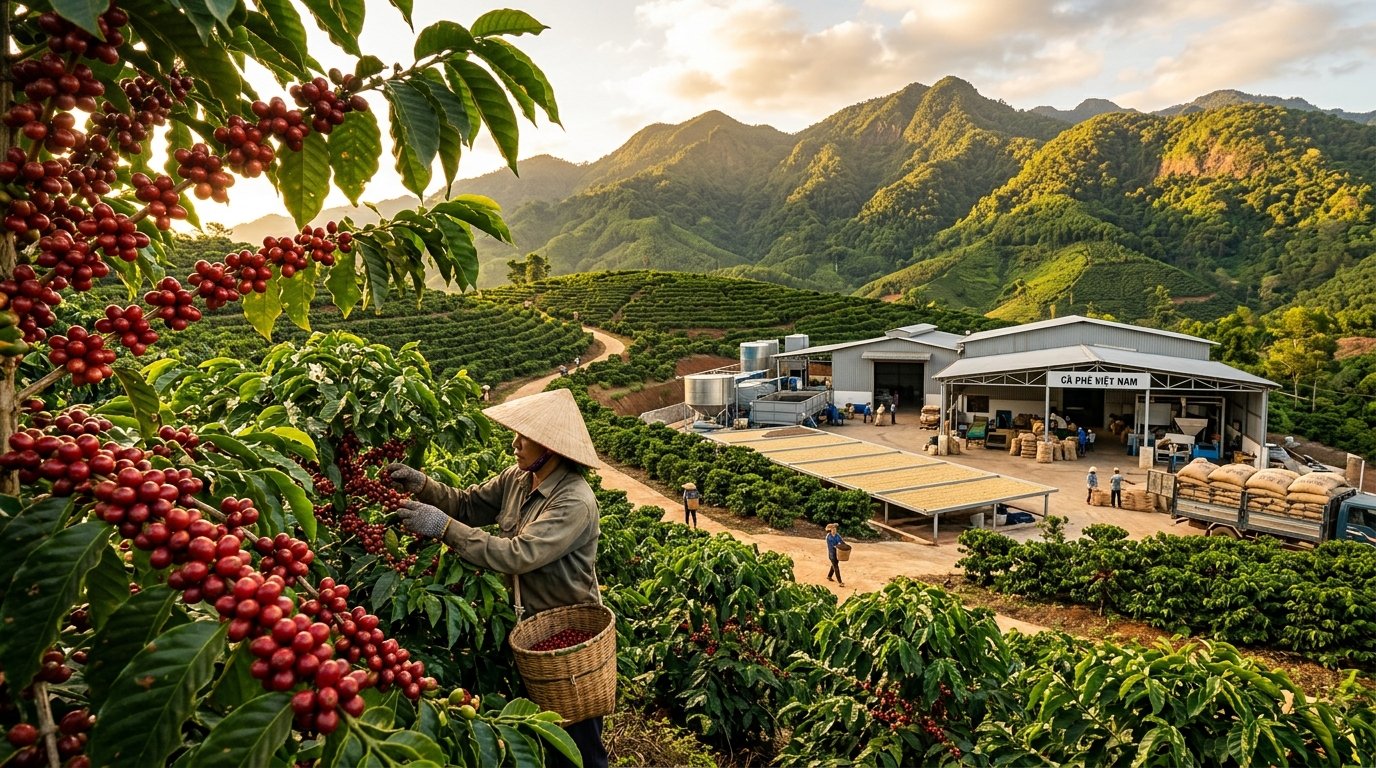
Vietnam is the world's second-largest coffee producer and the largest Robusta coffee exporter. With annual production exceeding 1.7 million tonnes and exports valued at over $4 billion, Vietnam is a powerhouse in the global coffee market.
This guide covers everything you need to know about sourcing coffee from Vietnam.
Vietnam Coffee: Key Statistics
| Metric | Value |
|---|---|
| Annual production | 1.7+ million tonnes |
| Global ranking | #2 (after Brazil) |
| Export value | $4+ billion/year |
| Robusta share | ~95% |
| Arabica share | ~5% (growing) |
| Major growing regions | Central Highlands (Dak Lak, Gia Lai, Lam Dong) |
Robusta vs. Arabica from Vietnam
Robusta (95% of production)
Vietnam is the world's largest Robusta producer. Vietnamese Robusta is known for its strong body, high caffeine content, and excellent blending characteristics.
- Use: Instant coffee, espresso blends, commercial blends
- Flavor profile: Bold, earthy, chocolatey, low acidity
- Growing altitude: 400–800m
- Price advantage: Significantly lower than Arabica
Arabica (5% of production, growing)
Vietnamese Arabica, grown in the Central Highlands (especially Lam Dong and Son La), is gaining recognition in specialty markets.
- Use: Specialty coffee, single-origin, premium blends
- Flavor profile: Fruity, floral, medium body, bright acidity
- Growing altitude: 1,000–1,600m
- Trend: Rapidly growing quality and recognition
Coffee Growing Regions
| Region | Province | Specialty |
|---|---|---|
| Central Highlands | Dak Lak | Largest Robusta region, world-class quality |
| Central Highlands | Gia Lai | Robusta, growing specialty segment |
| Central Highlands | Lam Dong (Da Lat) | Arabica, specialty coffee |
| Northern Vietnam | Son La | Arabica, high altitude, emerging region |
| Central Highlands | Dak Nong | Robusta, organic opportunities |
Processing Methods
- Natural (Dry): Cherries dried whole in the sun. Produces fruity, complex flavors. Growing in specialty markets.
- Washed (Wet): Cherries de-pulped and fermented before drying. Clean, bright cup profile.
- Honey Process: Partial de-pulping. Sweet, medium body. Increasingly popular for specialty.
- Wet-Polished: Common for commercial Robusta. Efficient large-scale processing.
Coffee Grades
Green Coffee (Robusta)
| Grade | Screen Size | Defects | Moisture |
|---|---|---|---|
| Grade 1 | 18+ | <10 defects/300g | 12.5% |
| Grade 2 | 16+ | <30 defects/300g | 12.5% |
| Grade 3 | 13+ | <60 defects/300g | 13% |
Certifications Available
- 4C (Common Code for the Coffee Community): Baseline sustainability
- Rainforest Alliance: Environmental and social standards
- UTZ (now Rainforest Alliance): Sustainable farming
- Fair Trade: Fair pricing for farmers
- Organic (USDA, EU, JAS): Chemical-free cultivation
- SCA Score 80+: Specialty grade (for Arabica)
How to Source Coffee from Vietnam
- Define your requirements: Robusta or Arabica, grade, certifications, volume
- Connect with verified coffee exporters (we can help)
- Request samples for cupping and quality evaluation
- Negotiate pricing, terms, and shipping schedule
- Arrange quality inspection before loading
- Ship (typically full containers, 18–20 tonnes each)
Pricing (Indicative)
| Product | FOB Price Range |
|---|---|
| Robusta Green (Grade 1) | $1,800–2,400/tonne |
| Robusta Green (Grade 2) | $1,600–2,100/tonne |
| Arabica Green (Specialty) | $3,500–6,000/tonne |
| Roasted Coffee (Private Label) | $4,000–8,000/tonne |
| Instant Coffee (Spray-Dried) | $3,000–5,000/tonne |
Prices are indicative and fluctuate with global commodity markets.
Interested in sourcing coffee from Vietnam? Contact Primo Sourcing to connect with verified Vietnamese coffee exporters.
Our sourcing team is based in Ho Chi Minh City, Vietnam with 10+ years of hands-on experience visiting factories, auditing suppliers, and managing export orders for international buyers across 30+ countries. Articles are based on our first-hand sourcing experience and verified industry data.
Learn more about our team →